
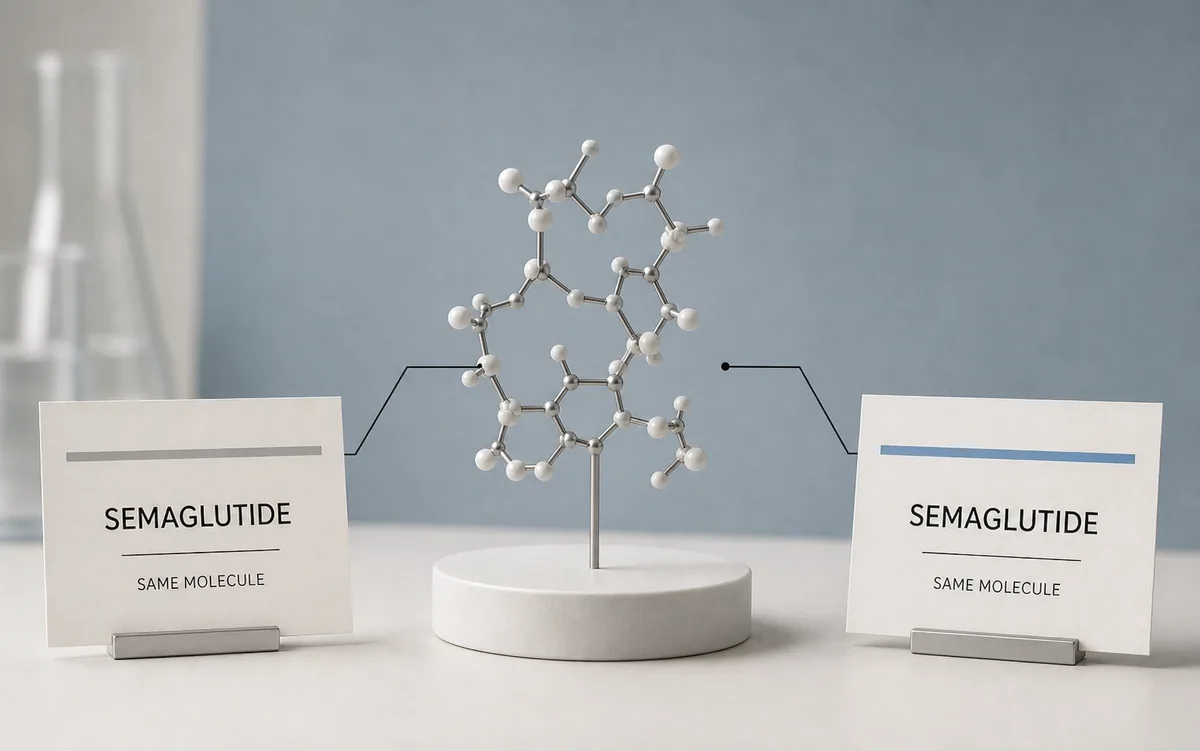
Wegovy and Ozempic are two branded prescription products that contain the same active compound: semaglutide. The receptor pharmacology is identical, because it is literally the same molecule. Both are GLP-1 receptor agonists. The brands differ because the manufacturer launched them for different therapeutic indications at different dose strengths.
Most researchers searching this comparison want to know whether they are looking at one molecule or two. The answer is one molecule, two brand presentations. What follows is the mechanism identity, not a clinical or product-substitution guide.
The compound: semaglutide
Semaglutide is a synthetic analog of native GLP-1, modified with a fatty-acid side chain. The 2015 paper describing its discovery details how that acylation lets the molecule bind albumin, which slows clearance and extends plasma half-life well beyond native GLP-1. It binds the GLP-1 receptor and triggers the same downstream cascade the native hormone does: glucose-dependent insulin release, satiety-pathway engagement, and slowed gastric emptying.
Both Wegovy and Ozempic deliver this molecule, so there is no mechanism-level difference between them. The FDA labels for Ozempic and Wegovy both name semaglutide as the active ingredient and describe it as a GLP-1 receptor agonist.
Why two brand names exist
Pharmaceutical brand strategy treats different therapeutic indications as separate products even when the molecule is the same. Ozempic launched first under one indication; Wegovy launched later under another, with a different titration schedule and a higher maximum dose. The naming follows the indication and the regulatory filing, not the chemistry.
From a research-pharmacology standpoint, the distinction is a labeling artifact. From a manufacturing standpoint, the vial contents trace back to the same synthesis. The active compound is semaglutide in both cases, and the receptor it engages does not know which box it shipped in.
Same mechanism, different dose strength
The dose-strength gap is the detail most often misread as a mechanism gap. It is not. A higher maximum strength changes the degree of receptor engagement, not the identity of the receptor or the shape of the downstream cascade. The GLP-1 signaling pathway is the same pathway whether it is engaged lightly or heavily, and semaglutide engages that one pathway in both products. Dose strength is a quantity, not a mechanism.
How this connects to research-grade semaglutide
Research-grade semaglutide is the chemical entity underneath both brands. Research applications use that entity directly, with sequence, mass, and HPLC purity verified per-lot, and without the brand-specific formulation overlays the commercial products carry.
Because semaglutide is now one of the most recognized molecules in metabolic medicine, it is also among the most misrepresented in unregulated supply. That is why per-lot mass-spec identity and HPLC purity matter for the research-grade form. The name on the label is common, and the only way to confirm the vial holds the molecule it claims is the COA, not the brand association.
This article describes mechanisms and applications studied in research models. NZM peptides are sold strictly for in vitro and animal research. They are not for human consumption, off-label use, or clinical application.
From the desk.
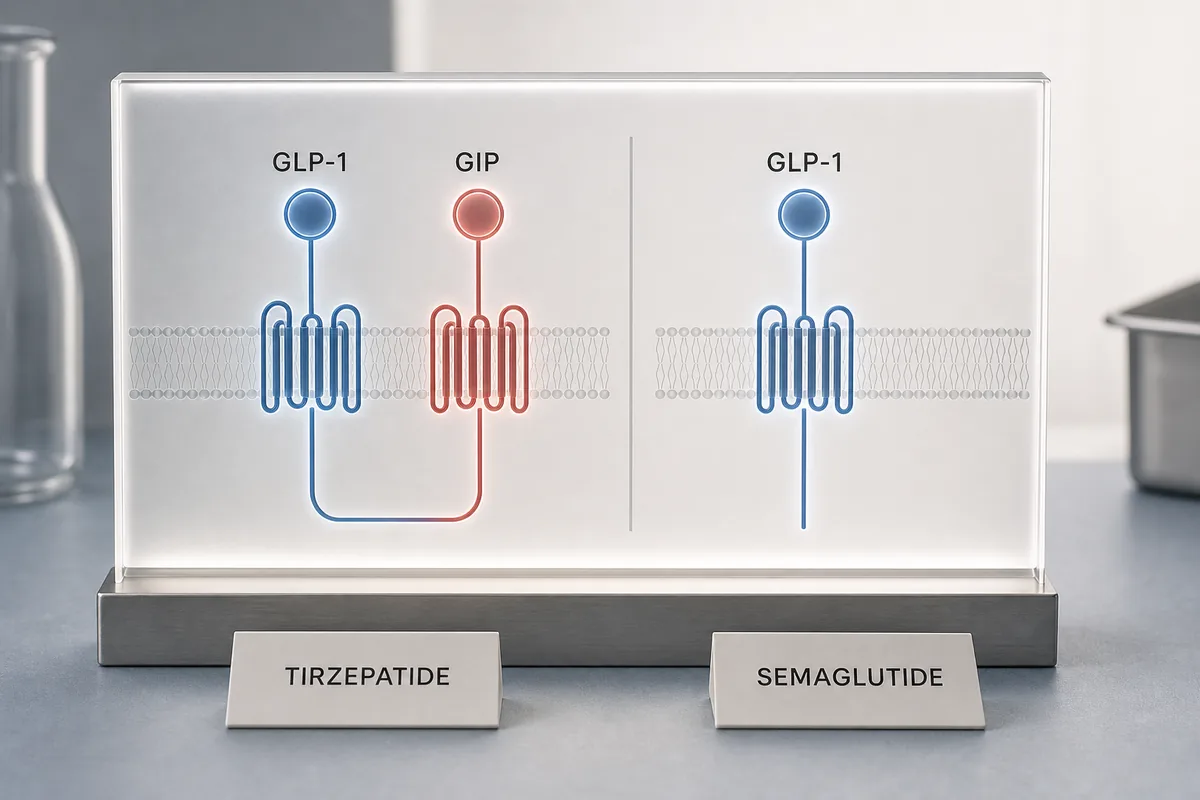
Mounjaro vs Ozempic: Tirzepatide (Dual Agonist) vs Semaglutide (GLP-1)
Mounjaro and Ozempic look like sibling products but contain different molecules. Mounjaro's compound activates two incretin receptors; Ozempic's compound activates one, and that mechanism gap is what actually separates them.

Retatrutide vs Ozempic: Research Compound vs Branded GLP-1
Ozempic is the branded prescription form of semaglutide. Retatrutide is a research-grade triple-agonist peptide. The names sit in different worlds, and the comparison researchers are usually asking is mechanism, not vendor.
GLP-1, GIP, and Glucagon: How Receptor Profile Shapes Research Outcomes
Single-pathway, dual, and triple agonists produce categorically different downstream effects. The receptor profile a molecule activates is the most consequential decision in any modern incretin-mimetic protocol.