
BPC-157 and TB-500 are the two deepest-cited tissue-repair peptides in the recovery research literature. They get mentioned in the same breath, and they get confused for each other, but they work on mechanistically distinct pathways. Sorting out the difference is the basis for deciding whether to run them as single compounds or as the pre-blended WOLVERINE stack.
Broadly, BPC-157 is studied for structural-tissue integrity and TB-500 for the cellular machinery of cell migration and new vessel growth. Same general territory, different mechanism.
BPC-157: structural protection
BPC-157 is a stable pentadecapeptide, a 15-amino-acid sequence derived from a protein found in human gastric juice. A 2021 review in Frontiers in Pharmacology from the group that has published most of the BPC-157 literature documents its activity across a wide range of tissues in research models: gastrointestinal tract, tendon, ligament, muscle, bone, nerve, and blood vessels. Its operating advantage is stability. It survives the GI tract intact, which keeps both injectable and oral protocol designs on the table in research models.
Its citation profile leans heavily toward tendon, ligament, and gut-tissue repair. Where a study concerns the structural integrity of connective or epithelial tissue, BPC-157 tends to be the reference compound. The mechanism is still being worked out, but the breadth of tissue models is part of why the compound draws sustained attention.
TB-500: cell migration and angiogenesis
TB-500 corresponds to the active region of Thymosin β-4, and its core mechanism is actin handling. A 1992 paper in the Journal of Cell Biology established Thymosin β-4 as the major G-actin-sequestering protein in cells: it binds monomeric actin and holds it in reserve, and that reserve is released when the cell needs to reorganize its cytoskeleton. Cytoskeletal dynamics are the upstream lever for cell migration.
The downstream effects follow from that. A 1999 study in the Journal of Investigative Dermatology reported that Thymosin β-4 accelerated wound re-epithelialization, increased collagen deposition and angiogenesis, and sped keratinocyte migration in research models. Where BPC-157 covers the structural axis, TB-500 covers the vascular and migratory one.
Why the two get confused
The confusion is understandable. Both are short peptides, both turn up in recovery research, and both get marketed in the same corner of the catalog. On mechanism, though, they barely overlap. BPC-157's story is about protecting and stabilizing tissue structure; TB-500's is about the actin machinery that lets cells migrate and vessels form. Treating them as two brands of one 'healing peptide' is the most common misreading, and it is the one that leads researchers to stack them when the question called for isolating one.
When to use each individually
A design isolating a specific mechanism benefits from a single compound. If a study measures tendon-tensile recovery and wants to attribute the response to a structural-repair compound, BPC-157 alone keeps the attribution clean. Adding TB-500 there introduces a confound the data cannot later separate.
The reverse holds for angiogenesis or vascular-driven re-epithelialization work, where TB-500 should be isolated. Stacking the two obscures the per-compound contribution, which is fine if you only care about the combined endpoint and a problem if you care about mechanism.
When the blend makes sense
The WOLVERINE blend (BPC-157 5mg plus TB-500 5mg per 10mg vial) is the operational default for combined-mechanism repair protocols. The pairing is the most-cited combined-mechanism reference in the recovery literature, which is part of why it exists as a pre-blend at all.
If the hypothesis is that engaging the structural and vascular pathways together produces something different from either alone, the pre-blended vial is the cleaner instrument. It removes per-vial reconstitution variance and fixes the ratio at synthesis instead of the bench, so the two compounds arrive in a known, repeatable proportion. Per-lot Janoshik HPLC verification reports identity and purity for each component, so that ratio is documented rather than assumed.
This article describes mechanisms and applications studied in research models. NZM peptides are sold strictly for in vitro and animal research. They are not for human consumption, off-label use, or clinical application.
From the desk.
Ipamorelin + CJC-1295: Paired GH-Secretagogue Mechanism in Research
Ipamorelin and CJC-1295 (no DAC) are the canonical GH-secretagogue research pairing. The pairing reflects complementary receptor pathways: ghrelin-receptor agonism plus GHRH-receptor agonism, not a single-mechanism stack.
Copper Peptides: Chemistry, Mechanism, and Dermal-Research Applications
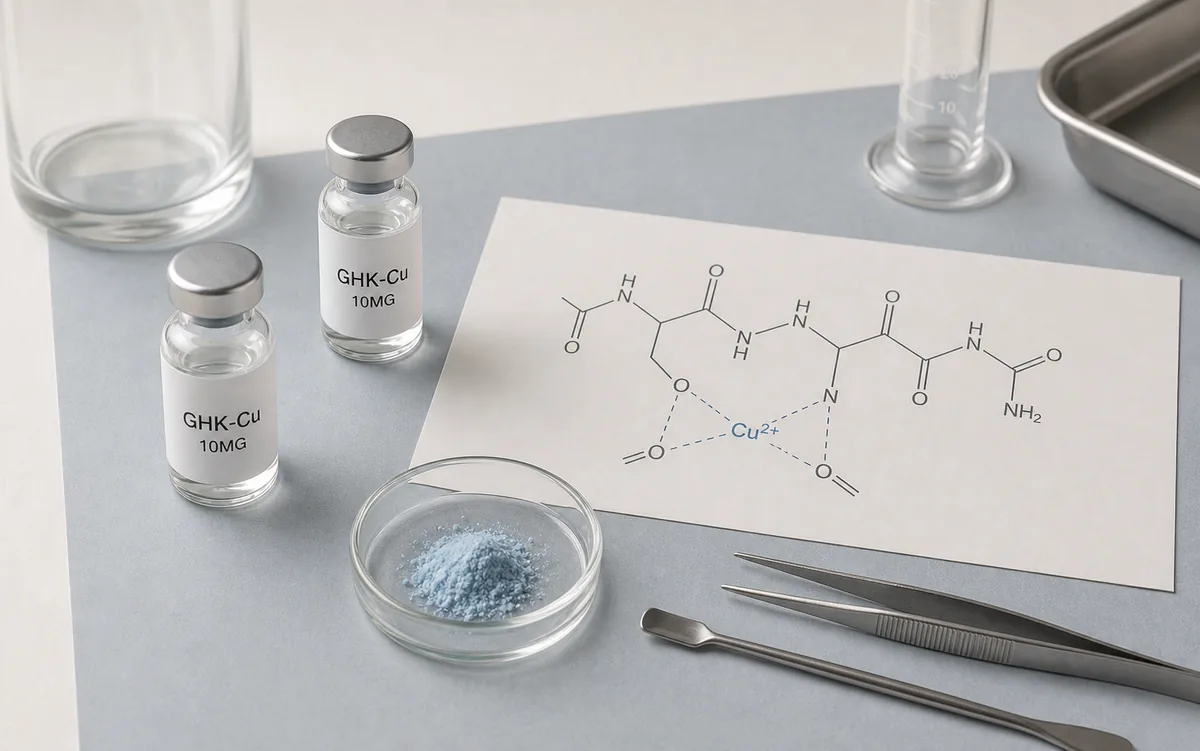
GHK-Cu is the most-cited copper peptide in dermal-research literature, but the wider class of tripeptide-copper complexes, including AHK-Cu, is what defines the category.
Reconstitution 101: How to Properly Prepare Lyophilized Peptides for Research
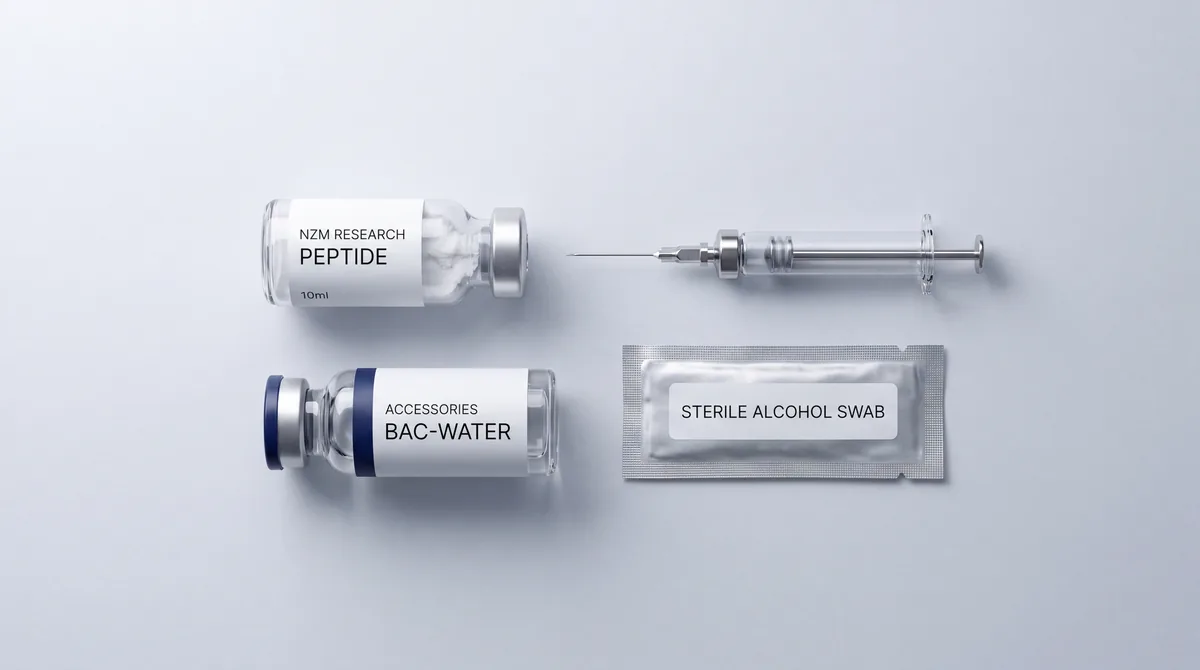
A practical lab-handling guide to reconstituting research-grade lyophilized peptides: choice of solvent, technique, post-reconstitution stability, and the operational mistakes that ruin protocol consistency.