
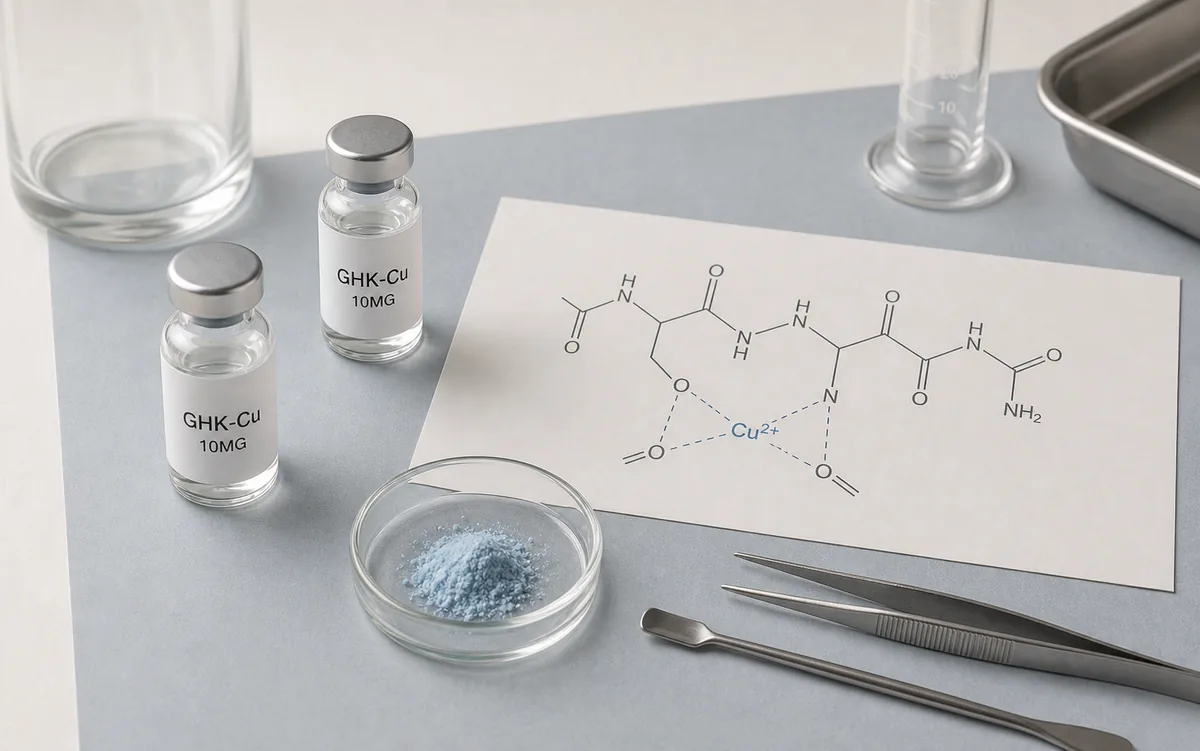
Copper peptides sit apart from most of the research-peptide catalog. They are not signaling molecules in the usual ligand-and-receptor sense. The active variable is the copper ion itself, carried into the cell on a short peptide scaffold that fixes its binding geometry and shapes the downstream gene-expression response. Take the copper away and the bare peptide loses most of its measurable activity in cell culture.
The class has a clear origin point. The biochemist Loren Pickart isolated the glycyl-histidyl-lysine tripeptide (GHK) from human plasma in 1973, after noticing that a fraction of human albumin made aged liver tissue synthesize protein the way younger tissue did. GHK circulates in plasma, saliva, and urine, and it binds copper(II) tightly at physiological pH. The copper-bound form, GHK-Cu, is the molecule the research literature is built on.
Two compounds anchor the category: GHK-Cu (glycyl-histidyl-lysine plus Cu²⁺) and AHK-Cu (alanyl-histidyl-lysine plus Cu²⁺). GHK-Cu carries the deeper citation history and the wider range of documented mechanisms. AHK-Cu is its closest structural analog, and the most useful comparison point when a research design wants to isolate what the first residue in the sequence actually contributes.
The copper ion is the active variable
Bare GHK, stripped of its copper, is an unremarkable tripeptide. What produces the characteristic transcriptional response is the Cu²⁺ ion held at the histidine site. In side-by-side cell-culture work, uncomplexed GHK and GHK-Cu show different gene-expression signatures, which is the clearest evidence that the metal, not the peptide on its own, is doing most of the work.
The coordination chemistry is what makes the peptide matter at all. The copper(II) ion is held at several points at once: the nitrogen of the histidine imidazole side chain, the nitrogen of the glycine alpha-amino group, and nearby carboxyl and amide groups. That geometry does something useful. A 2012 review in Oxidative Medicine and Cellular Longevity describes how binding the copper this way silences its redox activity, so the cell receives the copper it needs without the free-radical damage a loose Cu²⁺ ion would cause. The peptide keeps a reactive metal quiet until it is inside the cell.
This is also why correctly synthesized GHK-Cu carries a faint blue tint in the lyophilized state. Bare GHK is colorless; the blue is the bound copper. Color uniformity across a lot is one of the simplest visual checks a lab can run before release, though it confirms only that copper is present, not that the complex is intact to specification.
Because the copper is the active part, a copper-peptide lot raises a verification question that a plain peptide does not: how much copper is bound, and in what ratio to the peptide. Peptide purity measured by HPLC and copper content measured by an elemental method are two separate numbers. A lot can be high-purity peptide and still be under-complexed, which is why the even blue of a correct lot is a useful bench proxy but not a replacement for the assay values.
What the research literature documents
Most of the cited GHK-Cu mechanisms involve turnover of the extracellular matrix. The peptide stimulates synthesis of collagen, and also of dermatan sulfate, chondroitin sulfate, and the small proteoglycan decorin. It does this at very low concentrations, in the nanomolar range, which is part of why the early findings were treated with suspicion before other groups replicated them.
The same literature shows GHK-Cu modulating both the matrix metalloproteinases and their inhibitors, TIMP-1 and TIMP-2. That detail matters more than it first looks. The molecule stimulates both the synthesis and the breakdown of collagen and glycosaminoglycans, so it reads in the research as a remodeling signal rather than a simple growth promoter. It pushes tissue toward turnover rather than simple accumulation.
Two secondary mechanisms show up repeatedly. The first is antioxidant: GHK-Cu raises the activity of protective enzymes such as superoxide dismutase and quenches the reactive products of lipid peroxidation. The second is anti-inflammatory, with reduced TGF-beta signaling reported in human fibroblast culture. A 2015 review in BioMed Research International catalogs these alongside a much broader transcriptional effect, reporting that GHK can shift the expression of several thousand human genes in cultured cells, including 47 stimulated and 5 suppressed among the DNA-repair set alone.
These responses are documented across in-vitro fibroblast culture, ex-vivo skin-equivalent models, and animal-model studies. The spread of model classes is part of why the dermal-research literature treats the GHK-Cu profile as robust rather than an artifact of a single assay.
Wound-model repair and angiogenesis
Beyond steady-state matrix turnover, GHK-Cu is one of the more heavily studied peptides in wound-healing research models. Reported effects include faster wound closure, support for the formation of new blood vessels, and better-organized repair tissue rather than disordered scar. The angiogenic side has a clean mechanistic logic: copper is a known cofactor in the signaling that drives new vessel growth, and the tripeptide delivers it in a controlled form.
This is the same dual character the matrix data shows. GHK-Cu does not simply switch repair on. In the research models it appears to coordinate the sequence of breakdown and rebuild that ordered healing depends on, which is why it is studied as a regulator of the repair program rather than a single-axis stimulant.
Why GHK declines with age, and why that drives the research interest
One reason GHK-Cu draws sustained research attention is a plain observation about age. Plasma GHK runs at roughly 200 micrograms per liter in people aged 20 to 25 and falls to about 80 micrograms per liter by age 60 to 80. The decline tracks the general drop in regenerative capacity that comes with age, which has made GHK a candidate signal in studies of why tissue repair slows over a lifetime.
The framing in the literature is that GHK-Cu behaves less like a drug-style agonist and more like a regulatory peptide the body already uses and gradually loses. That sets a different research question from the one most peptides pose. It is less about adding a new signal than about restoring one that fades, which is why so much of the work sits in aging and matrix-repair models rather than acute-intervention designs.
GHK-Cu vs AHK-Cu vs other copper carriers
GHK-Cu and AHK-Cu share the histidine-coordinated copper geometry. The only difference in the sequence is the first residue: glycine in GHK, alanine in AHK. That single substitution is exactly why the pair is a useful comparison. Holding the histidine and lysine constant and changing only the N-terminal residue lets a research design ask what that position contributes to binding and to downstream effect.
AHK-Cu was engineered rather than borrowed from human plasma, and most of its citation history sits in follicle and dermal-papilla research. A 2007 study in Archives of Pharmaceutical Research reported that AHK-Cu, at concentrations between 10⁻¹² and 10⁻⁹ M, lengthened human hair follicles ex vivo and increased proliferation of dermal papilla cells, while lowering apoptosis markers (a raised Bcl-2/Bax ratio and reduced caspase-3 and PARP cleavage). It is the standard reference compound when AHK-Cu is the variable under study.
Other copper-carrying compounds are not interchangeable with the GHK class. Peptide-free copper salts and non-peptide copper carriers reach the cell by different routes and lack the controlled, redox-silenced delivery the tripeptide provides. This is why comparison studies routinely run bare copper sulfate (CuSO₄) as a control: it isolates what the peptide scaffold adds on top of the metal alone.
Operational notes
Copper peptides are stable in the lyophilized state and tolerate light well as a dry powder. Once reconstituted, the solution should be kept refrigerated and shielded from prolonged direct light to protect the copper-redox state. Standard 2 to 8°C storage applies after reconstitution, and most published protocols assume a reconstituted working window of around three weeks under those conditions.
For protocols where GHK-Cu is the only research variable, single-compound vials are the right choice. For combined-mechanism dermal-repair work, the GLOW blend (GHK-Cu 50mg + BPC-157 10mg + TB-500 10mg) fixes the ratio at synthesis and removes the per-vial reconstitution variance that protocol drift usually starts from. Per-lot identity and purity for each component are confirmed by Janoshik third-party HPLC verification.
This article describes mechanisms and applications studied in research models. NZM peptides are sold strictly for in vitro and animal research. They are not for human consumption, off-label use, or clinical application.
From the desk.
BPC-157 vs TB-500: Single Compounds or the WOLVERINE Blend?
Two of the most-cited tissue-repair peptides cover complementary mechanisms. When does a research protocol benefit from each individually, and when does the WOLVERINE blend make sense?
Ipamorelin + CJC-1295: Paired GH-Secretagogue Mechanism in Research
Ipamorelin and CJC-1295 (no DAC) are the canonical GH-secretagogue research pairing. The pairing reflects complementary receptor pathways: ghrelin-receptor agonism plus GHRH-receptor agonism, not a single-mechanism stack.
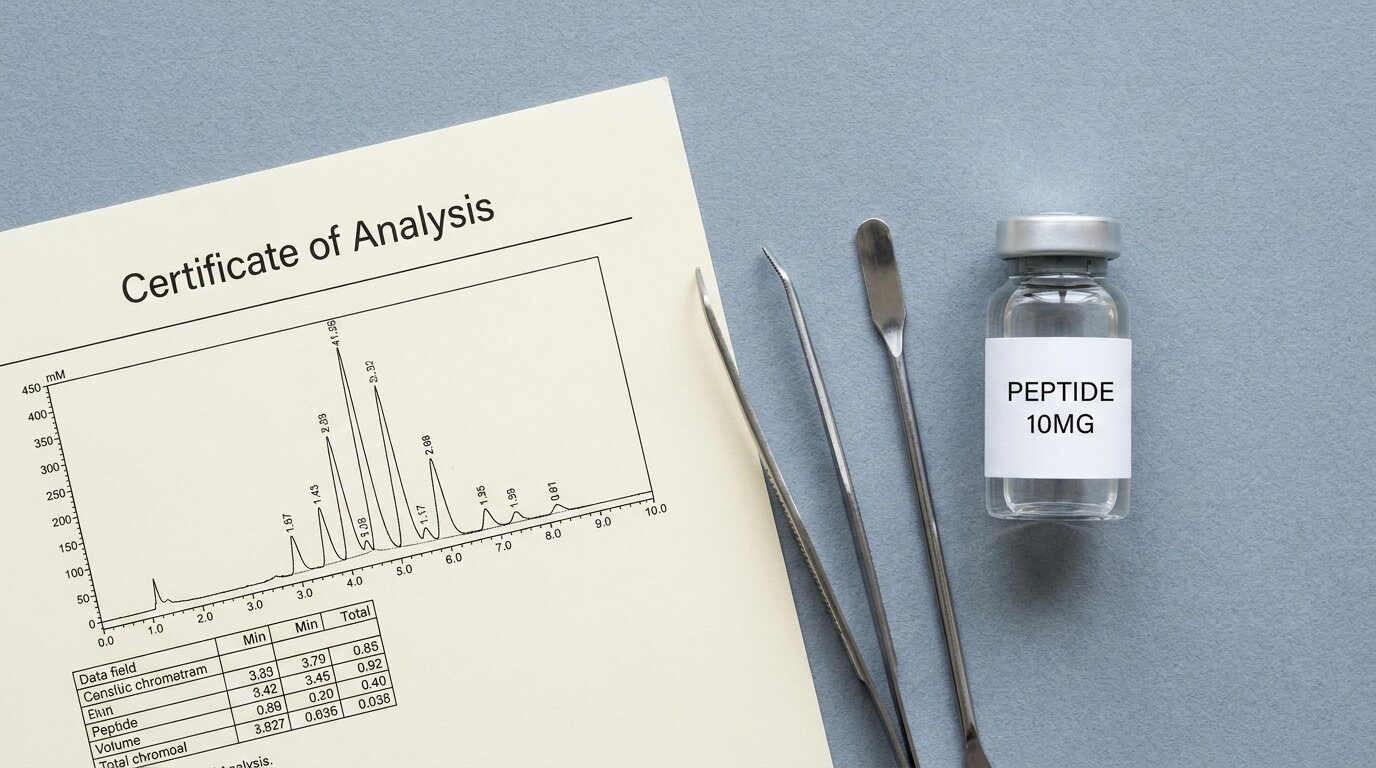
Why Janoshik Analytical: A Researcher's Guide to Independent Lab Verification
Independent third-party verification is the only credible way to certify what's actually in a research-grade peptide vial. Here's why Janoshik is the European reference, and what their COA actually tells you.