
Solid-Phase Peptide Synthesis: How Research-Grade Peptides Are Actually Made
Solid-phase peptide synthesis is the chemistry behind every research peptide in the modern catalog: how the process works, why it governs purity, and how to read a synthesis report on a COA.
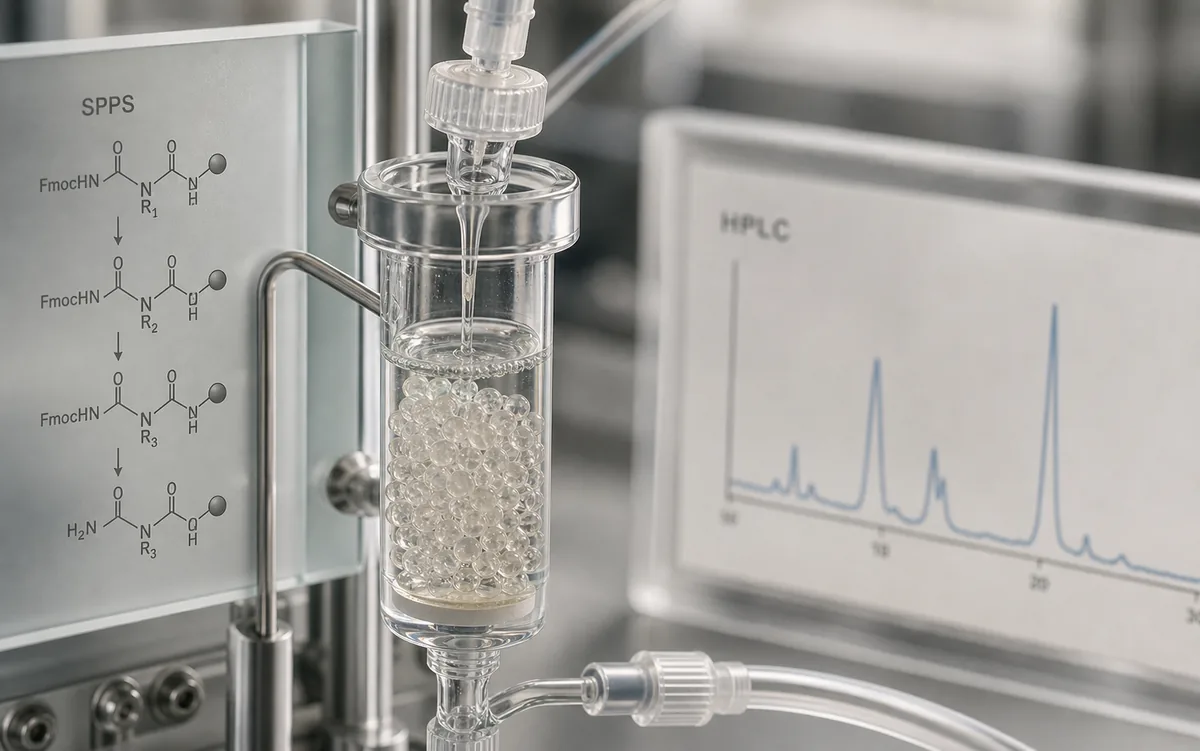
Every research peptide in a modern catalog, from BPC-157 to Retatrutide, is built one amino acid at a time on a polymer-resin support. The chemistry that makes that possible was first published by Bruce Merrifield in 1963, in a Journal of the American Chemical Society paper describing the synthesis of a tetrapeptide on a solid support. The technique is called solid-phase peptide synthesis (SPPS), and it underwrites the entire research-peptide supply chain.
Understanding how SPPS works is the basis for understanding why some lots are clean and others are not, why HPLC verification matters, and what the residual-solvent line on a COA is actually reporting. The process is elegant, and its failure modes are specific.
How the chemistry works
A peptide is grown C-terminus first, anchored to an insoluble polymer resin. Each residue is added in two steps: a deprotection step exposes the reactive end of the chain, then a coupling step joins the next protected amino acid through a peptide bond. Wash, and repeat. For a 15-residue peptide like BPC-157, the resin goes through fifteen coupling cycles and fifteen deprotection cycles before the chain is cleaved off and fully deprotected at the end.
The 'solid phase' is what makes this scalable. Because the growing chain stays tethered to the resin, every wash step rinses away unreacted reagents and side products by simple filtration. The peptide is only released into solution at the very end, once the chemistry is done. Modern practice mostly uses Fmoc chemistry for the protecting-group strategy; a 2016 review in the Journal of Peptide Science covers the Fmoc approach and the building blocks and conditions that keep the cycles clean.
Where impurities come from
A handful of failure modes dominate. Deletion sequences happen when a coupling step does not go to completion, leaving a chain short one residue. Racemization, the epimerization of a chiral center during coupling, produces an isomer that weighs the same but behaves differently. Side reactions such as aspartimide formation, flagged in the Fmoc-synthesis literature as a recurring problem, leave their own characteristic byproducts. And incomplete deprotection can leave a fragment still carrying a protecting group it should have shed.
These are why HPLC purity is the dominant quality signal. A clean chromatogram with one dominant peak above 99% area means the synthesis ran well. Extra peaks in the same retention window mean deletion sequences, isomers, or other byproducts are present and the lot has not been purified to specification. The chromatogram is, in effect, a readout of how disciplined the synthesis was.
Why mass-spec confirmation matters
HPLC area tells you whether the synthesis was clean. Mass spectrometry tells you whether the molecule is the right molecule. The theoretical mass calculated from the published sequence should match the measured monoisotopic mass within a fraction of a dalton. A larger gap means either a deletion sequence has shifted the peak, or the sequence in the vial is not what the label says.
This matters most for uncommon sequences. For something like Selank, MOTS-c, or any peptide with a non-standard residue, mass-spec identity confirmation is the only way to be sure the synthesis pipeline did not substitute or drop a residue somewhere in the chain. It is one of the four measurements on a complete Janoshik COA, and for unusual sequences it is arguably the most important.
What happens after synthesis
Once SPPS produces the crude peptide, the lot is purified by preparative HPLC, lyophilized to remove water, filled into vials under inert gas, sealed, and labeled. The lyophilization step is what yields the stable dry powder that ships and stores at −20°C. In that solid form, the peptide molecule itself is stable for a long time.
The COA comes last. A third-party analytical lab measures the finished lot against published methods and issues the report. The COA does not validate the synthesis, since the synthesis already happened. It validates that what came out of the synthesis matches what the label claims, which is the only question a downstream researcher actually needs answered.
Why the synthesis reaches the bench
A synthesis article belongs on a supplier's site because the synthesis is where vial quality is decided. Purity is not added later. It is either built in during the coupling cycles and the purification, or it is not there to find. Reading a COA with the synthesis in mind turns the numbers from marketing into diagnostics: the HPLC trace reports how the coupling went, the mass-spec line reports whether the sequence is intact, and the residual-solvent screen reports how thoroughly the crude was cleaned up. The document is a synthesis report as much as a sales sheet.
This article describes mechanisms and applications studied in research models. NZM peptides are sold strictly for in vitro and animal research. They are not for human consumption, off-label use, or clinical application.
From the desk.
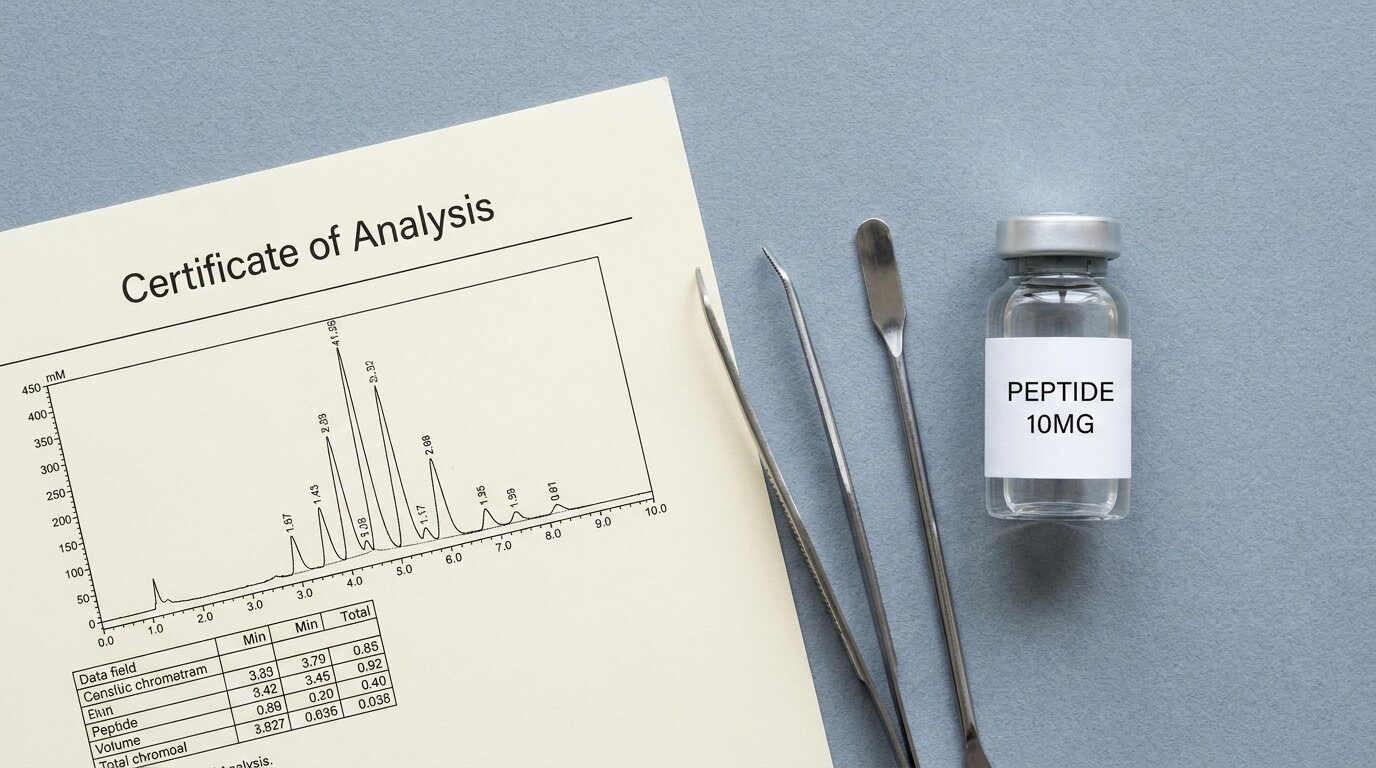
Why Janoshik Analytical: A Researcher's Guide to Independent Lab Verification
Independent third-party verification is the only credible way to certify what's actually in a research-grade peptide vial. Here's why Janoshik is the European reference, and what their COA actually tells you.
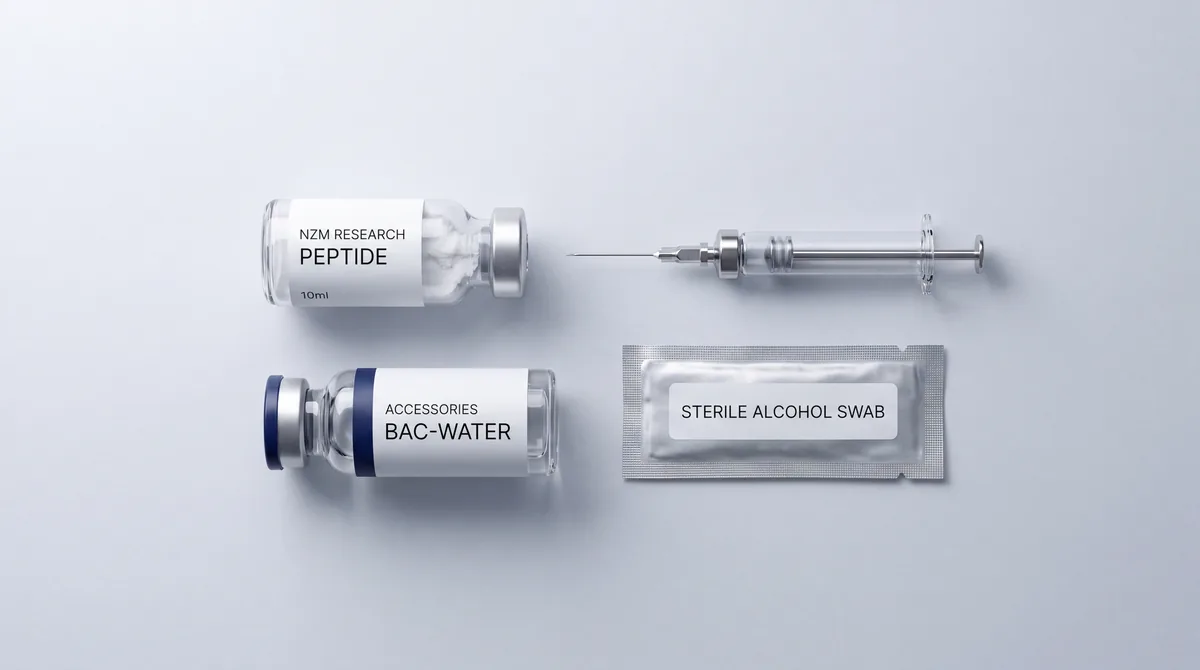
Reconstitution 101: How to Properly Prepare Lyophilized Peptides for Research
A practical lab-handling guide to reconstituting research-grade lyophilized peptides: choice of solvent, technique, post-reconstitution stability, and the operational mistakes that ruin protocol consistency.
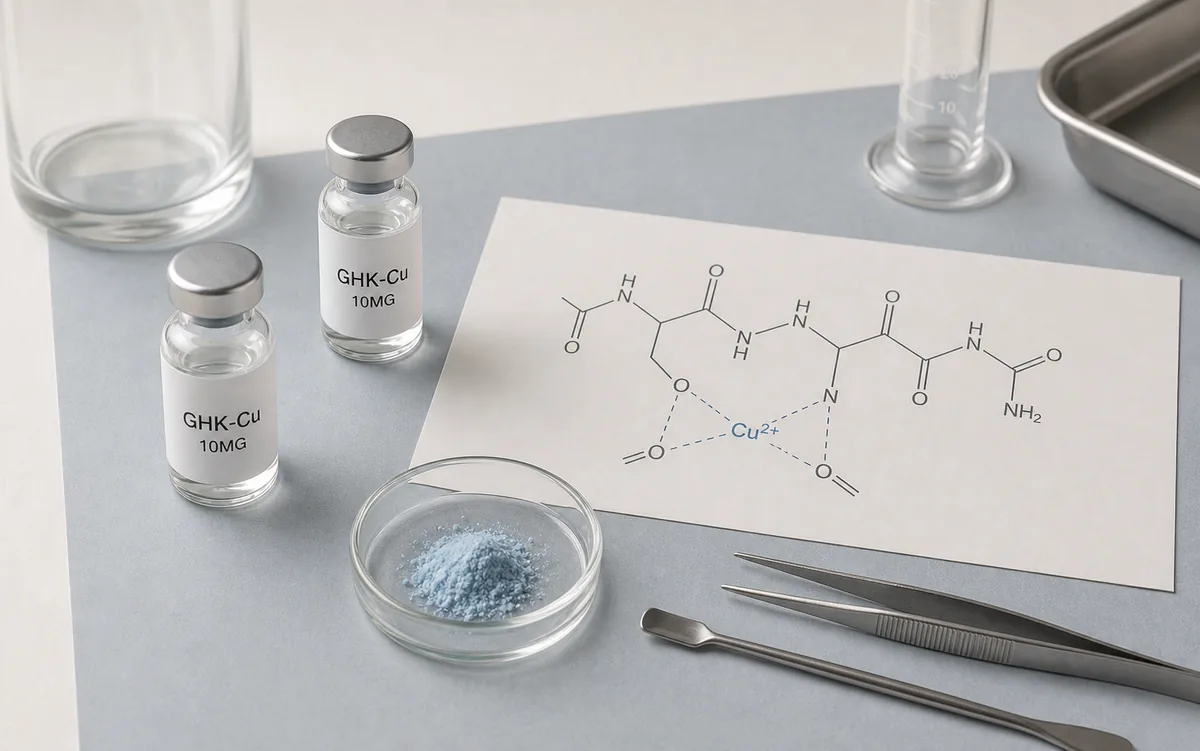
Copper Peptides: Chemistry, Mechanism, and Dermal-Research Applications
GHK-Cu is the most-cited copper peptide in dermal-research literature, but the wider class of tripeptide-copper complexes, including AHK-Cu, is what defines the category.